
Patrick Bayou


County: Harris
Parameters: Copper, water toxicity, sediment toxicity, temperature
Basin: San Jacinto River
Segment: 1006A
On this page:
- Background and Goals
- Watershed description
- Project Status and Implementation
- Public Participation
- For More Information
Background and Goals
Water quality testing prior to 1999 found that Patrick Bayou might not be sufficient to support a healthy aquatic community. Several conditions were found that exceeded criteria established to protect aquatic life and general uses of the water body:
- high average concentrations of dissolved copper
- water toxicity
- sediment toxicity
- high water temperatures
Additional data further supported the water quality concerns in Patrick Bayou. These data showed evidence of a degraded benthic macroinvertebrate community and levels of metals and organics that exceeded screening levels.
In response to these conditions, TCEQ initiated a TMDL project. A TMDL is like a budget — it determines the amount (or load) of a particular pollutant a body of water can receive and still support its designated uses. The allowable load is then allocated among categories of sources within the watershed, and measures to reduce pollutant loads are developed as necessary.
Watershed Description
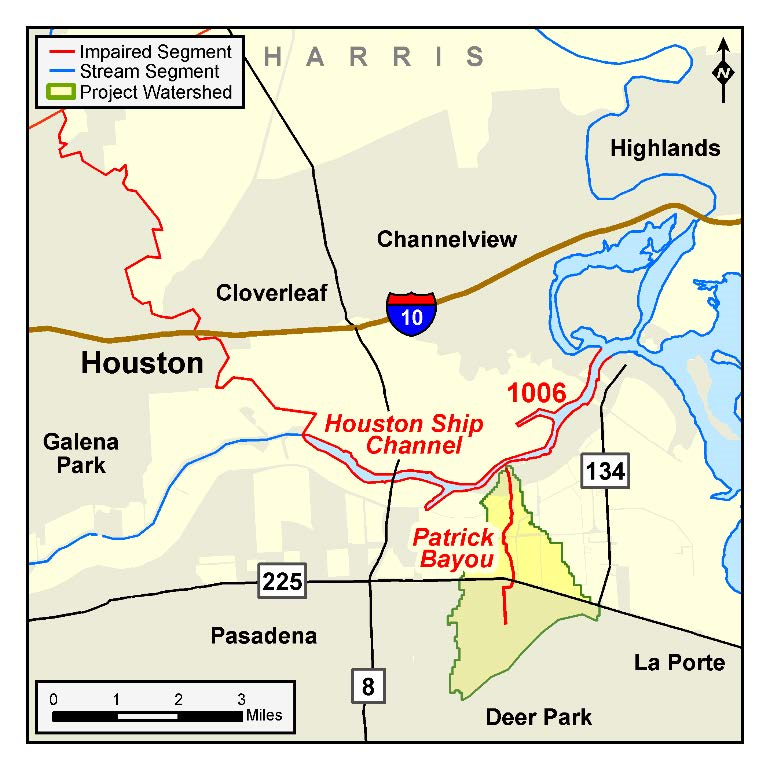
Patrick Bayou is a small tidal tributary of the Houston Ship Channel. The non-tidal portion of Patrick Bayou lies south of SH 225, is largely concrete lined, and serves as drainage for the City of Deer Park. Freshwater flow from the watershed is ephemeral. Immediately downstream (north) of SH 225, the first 1.3 km of the bayou flows through either concrete culverts or a gunite-lined channel. The bayou downstream of this point has earthen banks and a soft mud bottom. Most of the bayou north of SH 225 is tidally influenced to some degree. The bayou is affected by industrial and municipal wastewater discharges and by stormwater runoff from industrial and urban areas.
A majority of the bayou north of SH 225 is tidally influenced to some degree. The bayou is affected by industrial and municipal wastewater discharges and by storm water runoff from industrial and urban areas. The watershed includes portions Harris County and the city of Deer Park.
Project Status and Implementation
Analyses of data collected through April 2001 indicated that water toxicity and dissolved copper no longer exceeded water quality standards due to new limits implemented by dischargers. Those controls will continue, so no TMDL allocations to address water toxicity or dissolved copper were prepared. In September 2002, Patrick Bayou was added to the Superfund National Priority List. Progress in remediating sediment toxicity at the Patrick Bayou Superfund site is available on the EPA’s website . The major source of heated-water discharge has closed since the study, and bayou temperatures have not been observed to exceed the temperature criterion since then.
Public Participation
A named-member stakeholder group called the Patrick Bayou TMDL Community Participation Panel advised the TCEQ on this project. The lead organization working with the TMDL Program was a consortium of permittees that discharge to Patrick Bayou. The member organizations are the City of Deer Park, Lubrizol, Oxy Vinyls, Praxair, Rohm and Haas Texas, and Shell Inc. Parsons Water & Infrastructure Inc. performed technical work for the project. The last planned meeting of the Public Participation Panel occurred on August 29, 2002.
For More Information
For additional information regarding this project, please contact us at 512-239-6682. Or email tmdl@tceq.texas.gov, and mention the Patrick Bayou project in the subject line.
 Back to top