
Texas Relies on 1944 Treaty Water
As the manager of surface waters in the state, TCEQ works to protect the interests of Texas water right holders and monitor treaty compliance. Under the leadership of Commissioner Tonya R. Miller, TCEQ actively engages on border matters related to the 1944 Water Treaty and Rio Grande water management.
On this page:
1944 Treaty Overview
Mexico’s water deliveries in the international Rio Grande Basin are vital to ensuring that Texas water right holders can irrigate crops, supply water to municipalities, and conduct industrial operations along the Rio Grande.
Under the 1944 Treaty , Mexico is required to deliver 1,750,000 acre-feet (AF) of water to the U.S. over a five-year cycle, averaging 350,000 AF annually. Under the same Treaty, the United States continues to meet its annual obligation of providing 1.5 million AF from the Colorado River in the western U.S.
The International Boundary and Water Commission (IBWC), oversees the Treaty for the U.S. and works with Mexico to resolve issues that arise under its provisions. When Treaty deliveries from Mexico are reduced, Texas must adjust allocations from the international reservoirs— Amistad and Falcon —to Texas water-right holders.
Allocations in the Rio Grande Basin are administered through TCEQ’s Rio Grande Watermaster Program, which ensures water is distributed in accordance with both Texas law and international treaty obligations.
Reduced deliveries along the Rio Grande can significantly impact water users in Texas. In some cases, water users may need to secure alternate water supplies, adjust crop production, or reduce operations.
Rio Grande / Río Bravo Basin Watershed

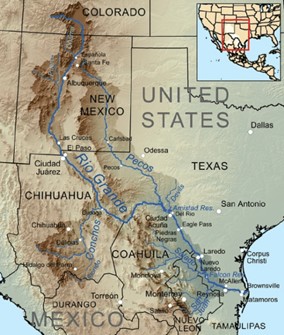
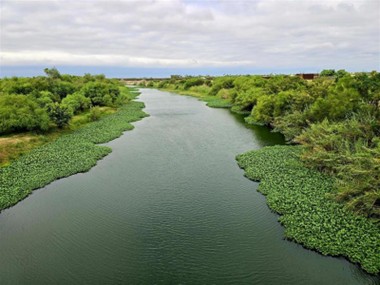

Treaty Deliveries and Current Status
- Mexico’s water deliveries are tracked by five-year Treaty cycles. Information on the volume of water Mexico delivered during the current 5-year cycle is available through IBWC’s data dashboard.
- Historical delivery data shows that there have been multiple instances where deliveries have fallen below Treaty requirements. View a history of Treaty deliveries.
- Current estimates of ownership (U.S. or Mexico) to water in—or flowing from—Amistad and Falcon are published weekly in the IBWC Reservoir Storage Report.
Rio Grande Watermaster Program
TCEQ’s Rio Grande Watermaster Program administers water rights within the basin and oversees allocation of available supplies. The program provides updates on reservoir ownership, water availability, and allocation percentages to ensure water is distributed in accordance with both Texas law and international Treaty obligations.
Read additional information about the Rio Grande Watermaster Program.
Minutes (Amendments) to the 1944 Water Treaty
Under the 1944 Water Treaty, a “Minute” (known as an “Acta” in Spanish) is a formal agreement adopted by the U.S. and Mexican sections of the International Boundary and Water Commission (IBWC). Minutes are comparable to amendments or implementing agreements to the Treaty and should not be confused with meeting minutes. View Minutes under the 1944 Water Treaty.
Correspondence and Federal Actions
The Rio Grande is a shared resource between the United States and Mexico. Federal, state and local leaders have issued correspondence and public statements emphasizing the importance of compliance with Treaty obligations.
- December 12, 2025 - Mexico Agrees to Meet Water Treaty Obligations
- November 21, 2025 - Governor Abbott Calls for Action on Mexico's Water Treaty Violation
- January 14, 2025 - U.S. Congressional Delegation to U.S. Senator Rubio
- November 23, 2024 - TCEQ to a Water Right Holder
- October 30, 2024 - Texas Farm Bureau to Texas Governor Abbott
- September 20, 2024 - Judge Trevino to TCEQ
- May 9, 2024 - IBWC to TCEQ
- May 7, 2024 - TCEQ to Rio Grande Watermaster Advisory Committee
- April 26, 2024 - TCEQ to IBWC
- April 4, 2024 - Rio Grande Watermaster Advisory Committee to TCEQ
- April 1, 2024 - IBWC to TCEQ
- March 19, 2024 - IBWC to TCEQ
- February 13, 2024 - TCEQ to IBWC
- January 31, 2023 - TCEQ to IBWC
- August 10, 2022 - IBWC to TCEQ
- July 27, 2022 - TCEQ to IBWC
- November 3, 2020 - IBWC to Texas Governor Abbott
- September 15, 2020 - Texas Governor Abbott to Secretary of State
- June 29, 2020 - Texas Governor Abbott to IBWC
- May 8, 2020 - Texas Senator Perry to U.S. Senator Cruz
- May 8, 2020 - Texas Senator Perry to U.S. Senator Cornyn
- May 4, 2020 - TCEQ to IBWC
- March 31, 2020 - Texas Representative Larson to IBWC
- March 23, 2020 - IBWC to Mexico
- January 24, 2020 - TCEQ to IBWC
- January 9, 2020 - Texas Representative Larson to President Trump
- September 17, 2014 - Texas Delegation to President Barack Obama
- September 3, 2014 - TWDB Chairman Carlos Rubinstein to IBWC Commissioner Edward Drusina
- August 26, 2014 - TWDB and TCEQ Chairs to Texas Representative Lucio
- August 1, 2014 - Texas Representative Lucio to TWDB and TCEQ Chairs
- July 9, 2014 - IBWC Commissioner Drusina to TWDB Chairman Rubinstein
- June 17, 2014 - TWDB Chairman Rubinstein to IBWC Commissioner Drusina
- September 10, 2013 - TDA Commissioner Staples and TWDB Chairman Rubinstein to U.S. Ambassador to Mexico E. Anthony Wayne
- June 11, 2013 - U.S. State Department to Commissioner Rubinstein
- May 22, 2013 - Commissioner Rubinstein to U.S. State Department
- June 10, 2013 - TCEQ to IBWC
- April 26, 2013 - IBWC to TCEQ
- April 22, 2013 - TCEQ to IBWC
- April 18, 2013 - Lower Rio Grande Valley Water District Manager's Association to TCEQ
- April 15, 2013 - Texas Citrus Mutual to U.S. State Department
- April 11, 2013 - Congressional Delegation to President Obama
- April 9, 2013 - Texas Governor Perry to President Obama
- April 9, 2013 - Rio Grande Regional Water Authority to U.S. Representative Vela
- April 9, 2013 - Cameron County Irrigation District to U.S. Senator Cornyn
- April 9, 2013 - Delta Irrigation District to U.S. Senator Cornyn
- April 5, 2013 - IBWC to Congressional Delegation
IBWC Citizen Forums
The International Boundary and Water Commission (IBWC) hosts Citizen Forums to provide public updates and receive input regarding water management along the U.S.–Mexico border. These forums offer stakeholders and community members an opportunity to learn about Treaty implementation, reservoir conditions, and binational water coordination efforts.
Information about upcoming forums and materials from past meetings is available on the IBWC Citizen Forums webpage
Resources
- Learn about the economic impact of irrigation water shortages on agriculture in the Lower Rio Grande Valley.
- Texas Commission on Environmental Quality and Texas Department of Agriculture outline Mexico's Water Deficit to the United States.
- The Rio Grande Regional Water Planning Group works with state agencies and local stakeholders to develop and update a Regional Water Plan.
- Mexico’s National Water Commission (CONAGUA) administers national waters, manages and controls the country's hydrological system, and promotes social development.