
Fort Worth Area
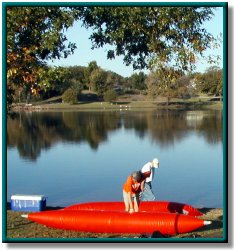
Lake Como
Photo courtesy of the
United States Geological Survey


County: Tarrant
Parameter: Legacy Pollutants
Basin: Trinity River
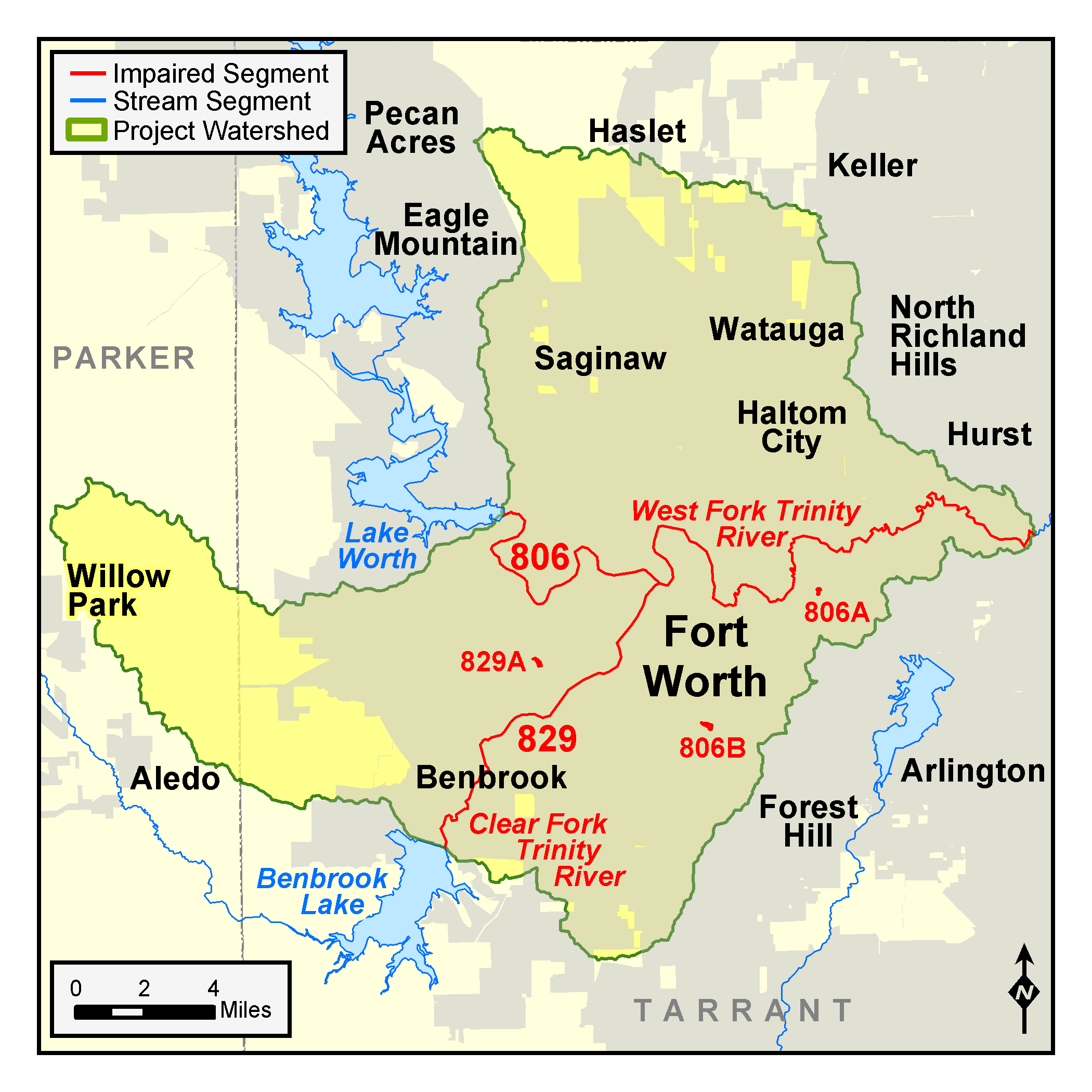
Segments: 0806, 0806A, 0806B, 0829, 0829A
On this page:
- Background and Goal
- Description of the Project Area
- Approved I-Plan
- Adopted TMDLs
- Status
- Public Participation
Background and Goal
As early as 1990, six legacy pollutants were detected in fish tissues in several water bodies in the Fort Worth area. Legacy pollutants are chemicals whose use has been banned or severely restricted, but which still remain in the environment. The pollutants involved include chlordane, DDT, DDE, dieldrin, and PCBs, most of which were once used as insecticides. As a result, the Texas Department of State Health Services (DSHS) closed the water bodies for fishing and cautioned consumers that they should not eat fish from these water bodies.
The goal of this TMDL project is the reduction of fish tissue contaminant concentrations to levels that constitute an acceptable risk to consumers. TCEQ also developed an implementation plan establishing measures to achieve this goal.
Description of the Project Area
The Trinity River segments in this project drain a watershed of 295 square miles, 62 percent of which is urban. However, until the 1970s, agricultural uses dominated much of the land south Fort Worth and a large area in the northern portion of the watershed. The three small reservoirs in this project are in public parks within the city of Fort Worth and impound small drainage tributaries that collect stormwater. The watershed includes the following segments:
- Clear Fork Trinity River Below Benbrook Lake (Segment 0829)
- Lake Como (Segment 0829A)
- West Fork of the Trinity River Below Lake Worth (Segment 0806)
- Fosdic Lake (Segment 0806A)
- Echo Lake (Segment 0806B)
Approved I-Plan
The commission approved the I-Plan on July 13, 2001.
Adopted TMDLs
Widespread use of the chemicals addressed in this TMDL has been either banned or restricted since 1987. Recent sediment and fish tissue samples collected in some of these water bodies suggest that legacy pollutant levels are diminishing. Given the fact that no additional pollutant loading can legally occur in these water bodies, the maximum permissible daily load allowable is, in effect, zero.
The commission adopted these TMDLs on Nov. 17, 2000. EPA approved them on May 24, 2001, at which time they became part of the state's Water Quality Management Plan.
-
Eleven TMDLs for Legacy Pollutants in Streams and Reservoirs in Fort Worth
Segments: 0806, 0806A, 0806B, 0829, and 0829A - Response to Public Comment on the TMDLs
Status
In 2001, the City of Fort Worth began implementing mitigation measures, including a hazardous waste collection center and evaluating remediation strategies.
In November 2005, the Texas Department of State Health Services (DSHS) collected fish tissue samples from Como, Fosdic, and Echo lakes to reassess the risk associated with consuming fish from those areas. As a result of the study, DSHS lifted the fish possession ban on Lake Como, modified the ban on Fosdic Lake to a consumption advisory, and retained the ban on Echo Lake.
TCEQ contracted with DSHS to collect fish tissue samples and reassess the fish consumption risk in the Trinity River segments. Sampling was conducted in June and July 2008.
In July 2010, the DSHS issued a no-consumption advisory for West Fork Trinity River and Clear Fork Trinity River due to elevated levels of PCBs and dioxins in fish. Chlordane is no longer considered a contaminant of concern.
TCEQ contracted again with DSHS to collect fish tissue samples and reassess the fish consumption risk in Lake Como, Fosdic Lake, and Echo Lake. Sampling was conducted April 2014.
In December 2015, DSHS issued a consumption advisory for common carp and largemouth bass in Echo Lake due to dieldrin, dioxins, and PCBs. Also in 2015, the advisory for Fosdic Lake was retained with no changes.
In February 2016, DSHS issued a no consumption advisory for common carp in Lake Como due to dieldrin, dioxins, and PCBs.
TCEQ contracted with DSHS to collect fish tissue samples in 2019. In August 2019, fish tissue samples were collected at various sites on Clear Fork Trinity and West Fork Trinity rivers.
Public Participation
TCEQ communicates the progress of this project through the Trinity Basin Steering Committee created by the Texas Clean Rivers Program. This project is a collaborative effort involving TCEQ, DSHS, the City of Fort Worth, and the Trinity River Authority (TRA).
For More Information
Please email tmdl@tceq.texas.gov and mention Fort Worth legacy pollution in the subject line. Or call us at 512-239-6682.
 Back to top