
Texas Nonpoint Source Management Program
On this page:
TCEQ and the Texas State Soil and Water Conservation Board (TSSWCB) jointly update the Nonpoint Source Management Program every five years.
The Texas Nonpoint source Program accomplishes the following:
- Incorporates the EPA's eight components of an effective program.
- Establishes long- and short-term goals for the program.
- Provides coordination of nonpoint source-related programs and activities conducted by federal, state, regional, and local entities.
- Prioritizes assessment, planning, and implementation activities in priority watersheds and aquifers.
Approved 2022 Texas Nonpoint Source Management Program
The 2022 Texas Nonpoint Source Management Program was adopted by the TCEQ Commissioners on December 15, 2021, submitted to the U.S. Environmental Protection Agency by the Texas Governor, and approved by EPA on August 29, 2022.
Draft 2027 Texas Nonpoint Source Management Program
The Draft 2027 Texas Nonpoint Source Management Program will be available for public comment July 3, 2026 to August 3, 2026. Please see the 2027 NPS Management Program Summary of Changes document for a list of updates.
Written Comments
Please choose one of the methods provided to submit your written comments. Written comments on the draft Texas Nonpoint Source Management Program may be submitted to Kristin DeBone, Water Quality Planning Division, Texas Commission on Environmental Quality, MC 203, P.O. Box 13087, Austin, Texas, 78711-3087; or eFaxed to 512-239-1414. Electronic comments may be submitted at the TCEQ Comment Input website . File size restrictions may apply to comments being submitted via the TCEQ Public Comment system. All written comments must be received at TCEQ by August 3, 2026, and should reference Texas Nonpoint Source Management Program.
Public Meeting
A public meeting for the draft document was an in-person and virtual meeting on July 15, 2026, at 10:00 a.m.
For a copy of the presentation and meeting transcript, please email nps@tceq.texas.gov.
Download the public notice for the request for public comments and a public meeting on the draft 2027 Texas Nonpoint Source Management Program in English or Spanish for more information.
 Back to top
Program Achievements
EPA began officially recognizing contributions towards restoring impaired water bodies and publishing them as success stories in 2008. Since then, the TCEQ and TSSWCB Nonpoint Source programs have annually presented success stories that highlight work that led to successful restoration of over 25 water bodies across the state.
The most recent EPA-approved Success Story for TCEQ was the Tres Palacios Tidal (AU 1501_01). A list of other Success Stories for Texas can be found below and on EPA's website.
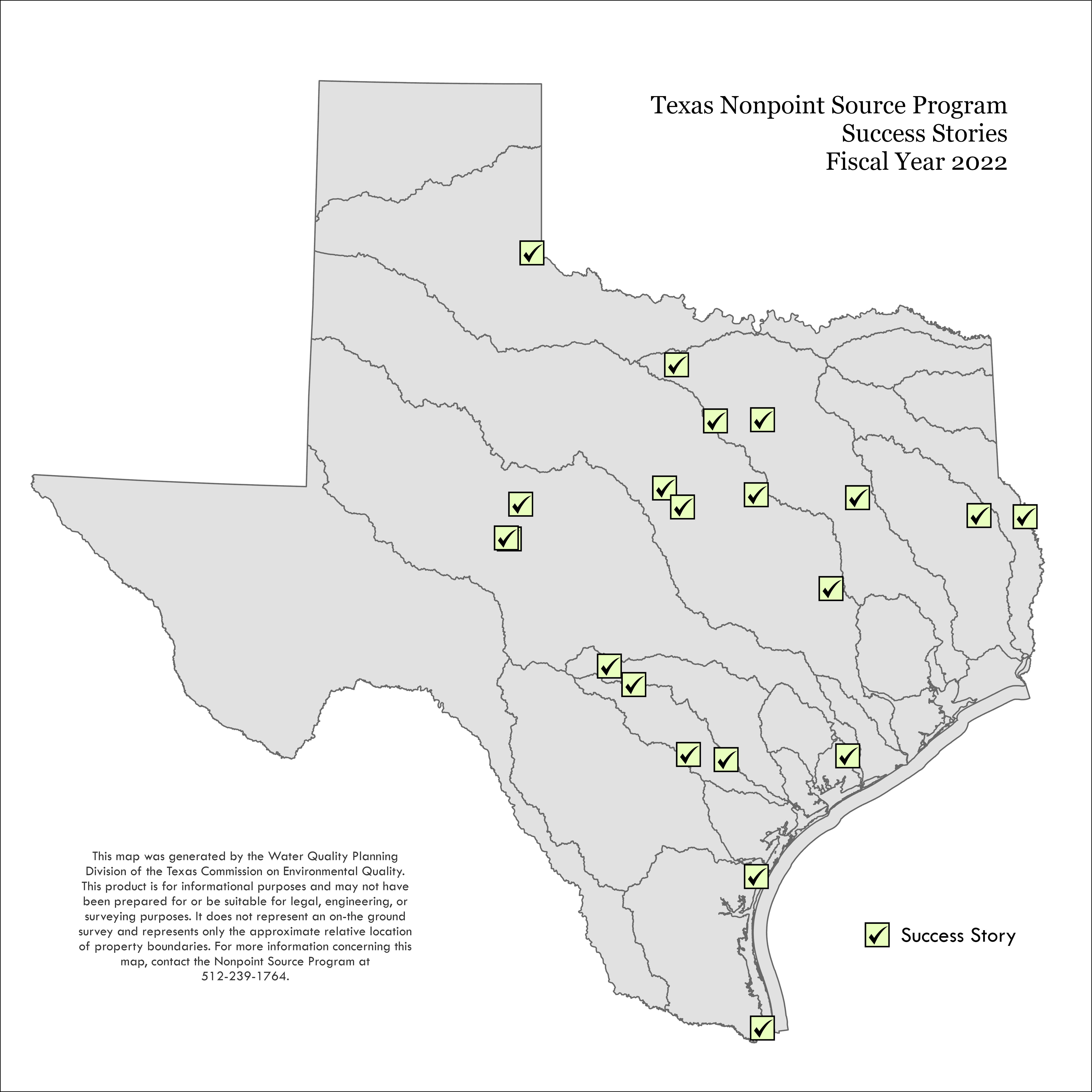 Nonpoint Source Success Stories Map
Individual Success Stories:
- Aquilla Reservoir
- Attoyac Bayou
- Brownsville Ship Channel
- Buck Creek
- Catfish Creek
- Colorado River Below E.V. Spence Reservoir
- Concho River
- Dickinson Bayou
- Fosdic Lake
- Guadalupe River Above Canyon Lake
- Highland Bayou Diversion Canal
- Lake Como
- Leon and South Leon rivers
- Little River
- Lower Nueces River
- Lower San Antonio River
- Navasota River
- North Fork Rocky Creek
- Oso Bay
- Sulfur Creek
- Toledo Bend Reservoir
- Tres Palacios Creek
- Tres Palacios Tidal
- Upper Cibolo Creek
- Leon and South Leon River
- Upper Leon River and Pecan Creek
- Upper San Antonio River (AU 1911_02)
- Upper San Antonio River (AU 1911_07)
- West Fork Trinity River
For More Information
To find out more about the NPS Program, call 512-239-6682 or e-mail us at nps@tceq.texas.gov.