
Texas Voluntary Marginal Conventional Well Plugging Program (TxMCW)
Owners and operators of marginal conventional wells in Texas may be eligible for assistance to voluntarily plug and abandon select wells.
About the Texas Voluntary Marginal Conventional
Well Plugging
Program (TxMCW) (0:39)
Program Status
TxMCW is currently accepting Requests for Grant Applications (RFGA) from marginal conventional well (MCW) owners and operators who are interested in permanently plugging and abandoning their oil and/or gas wells.
Vendor responses for the Requests for Proposals (RFP) closed Aug. 31, 2026.
Sign up for updates to get the latest TxMCW news.
Submit a Well Application
Applications will be accepted until 5 p.m. CT, Nov. 9, 2026.
- You must submit an individual application for each well.
- Applications will only be accepted using our secure site.
| How to Apply | Application Process |
|---|---|
| Step 1: Determine if you are eligible |
Eligible applicants Individuals, corporations, or any other legal entity. Eligible wells Wells must:
|
| Step 2: Collect documents and fill out forms |
|
| Step 3: Submit your application |
Upload your completed application and required supporting documentation using our secure site:
|
- We will evaluate and score applications in accordance with the prioritization criteria found in the RFGA.
- See TCEQ’s Well Prioritization Plan for detailed information on how TxMCW will select wells for plugging.
Well Prioritization Plan
TCEQ’s Well Prioritization Plan describes how TxMCW will select wells for plugging.
View Well Prioritization Plan (PDF) Prioritization criteria include but are not limited to:- Existing emissions data or initial screening data
- Production rates
- The number of wells operated by an owner
- Potential human health and environmental impacts, among others
Weighted criteria will be used to generate a ranked list of wells that are recommended candidates for plugging.
Methane Measurement Plan
TCEQ's Methane Measurement Plan describes how the detection and measurement of methane emissions before and after well plugging activities will be conducted at participating MCWs. Methane detection is required for all MCWs selected for funding under the program. This plan is based on DOE's Methane Measurement Guidelines for MCWs .
View Methane Measurement Plan (PDF)
Well Landscape in Texas
The oil and gas well landscape in Texas is vast and unique. The Railroad Commission tracks oil and gas well data in Texas.
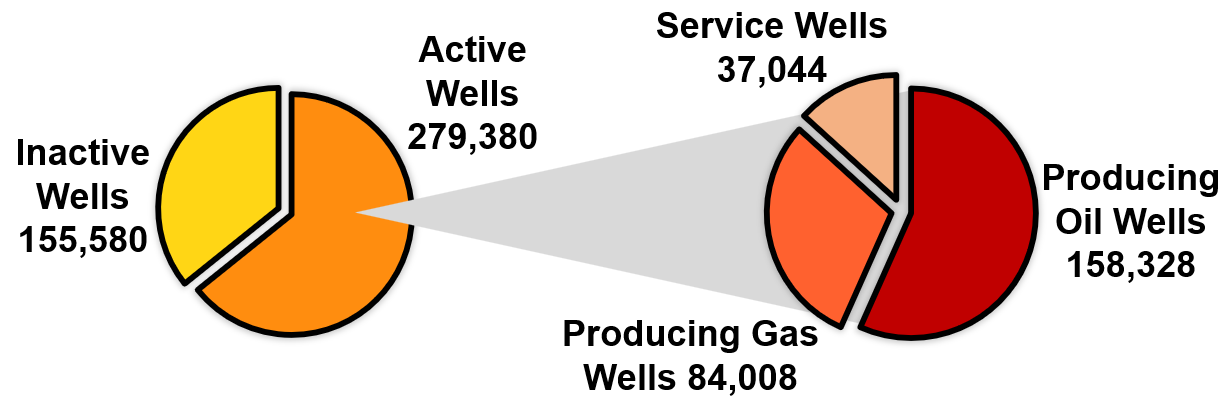
There are 432,634 oil and gas wells in Texas. Of those, 277,016 are active, and 155,618 are inactive.
| Type of Well | Number of Wells |
|---|---|
| Active Wells | 277,016 |
| Inactive Wells | 155,618 |
Of the 277,016 active oil and gas wells in Texas, 156,120 produce oil, 84,661 produce gas, and 36,235 are service wells.
| Type of Well | Number of Wells |
|---|---|
| Producing Oil Wells | 156,120 |
| Producing Gas Wells | 84,661 |
| Service Wells | 36,235 |
It’s important to note that not all of these are marginal wells, but this data does help us get an idea of what we’re working with as we strategize our initiatives moving forward.
The above data is sourced from the Texas Railroad Commission and current as of May 31, 2026.
TxMCW Program Background
TCEQ was awarded $134.1 million under the Inflation Reduction Act’s Methane Emissions Reduction Program (MERP). With this funding, TCEQ has developed TxMCW.
Marginal or low-producing oil and gas wells, and the supporting production equipment, are a significant source of methane emissions and other air pollutants.
Permanently plugging and abandoning low-producing oil and gas wells can prevent harmful emissions from leaking into the atmosphere.
In addition to reducing methane emissions, well plugging activities may:
- Reduce local air pollution: Reduces emissions of volatile organic compounds and hazardous air pollutants such as benzene, toluene, ethylbenzene, and xylene, and, in some cases, hydrogen sulfide.
- Reduce hazards to groundwater: Reduces chance of wells leaking liquids underground where oil, salt, and toxic minerals could migrate into aquifers that supply water to cities, farms, and ranches.
- Reduce fire hazards: Reduces emissions of explosive gases, therefore reducing the risk of fires and explosions.
TxMCW aims to reduce a variety of common harmful emissions, each with distinct associated attributes and adverse effects.
Hazardous Air Pollutants (HAPs)-
Commonly called:
- Toxic air pollutants
- Air toxics
- Most HAPs fall in the VOC category, but not all
-
Specifically regulated because they are known or suspected to
cause serious health impacts such as:
- Cancer
- Reproductive effects
- Birth defects
- Immune system damage
- Adverse environmental effects
-
Examples of HAPs include:
- Benzene
- Toluene
- Ethylbenzene
- Xylene
- Colorless
- Odorless
- Flammable
- Comprised of one carbon atom and four hydrogen atoms
- A greenhouse gas that traps heat in the atmosphere
- Contributes to the creation of ground-level ozone
- Chemicals with high vapor pressure and low water solubility
- Key precursors in the creation of ground-level ozone
- Can contaminate groundwater
- Can cause short- and long-term effects in humans and animals