
Chocolate Bayou
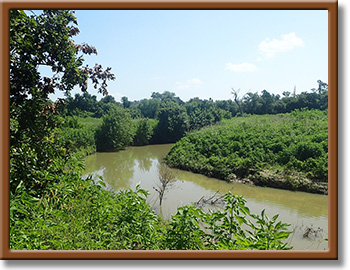
Photo Courtesy of the
Houston-Galveston Area Council

Counties: Brazoria, Fort Bend
Parameter: Bacteria
Basin: San Jacinto-Brazos Coastal
Segments: 1107, 1108
Assessment Units (AUs): 1107_01, 1108_01
On this page:
- Background and Goal
- Watershed Description
- Get Involved
- Adopted TMDLs
- Reports
- Contact the TMDL Program
Background and Goal
Since 2010, high concentrations of bacteria, which are found in both human and animal waste, have been observed in the bayou. The presence of these bacteria may indicate a health risk to people who swim or wade in the bayou—activities referred to as “contact recreation” in the Texas Surface Water Quality Standards.
The goal of this project is to improve water quality in order to protect recreational uses. Toward that goal, TCEQ and stakeholders are developing TMDLs for bacteria in the bayou. Stakeholders will also develop a regional I-Plan to reduce bacteria in Chocolate Bayou, Halls and Willow bayous, and Mustang Bayou, all of which are in the larger watershed of Chocolate Bay.
Watershed Description
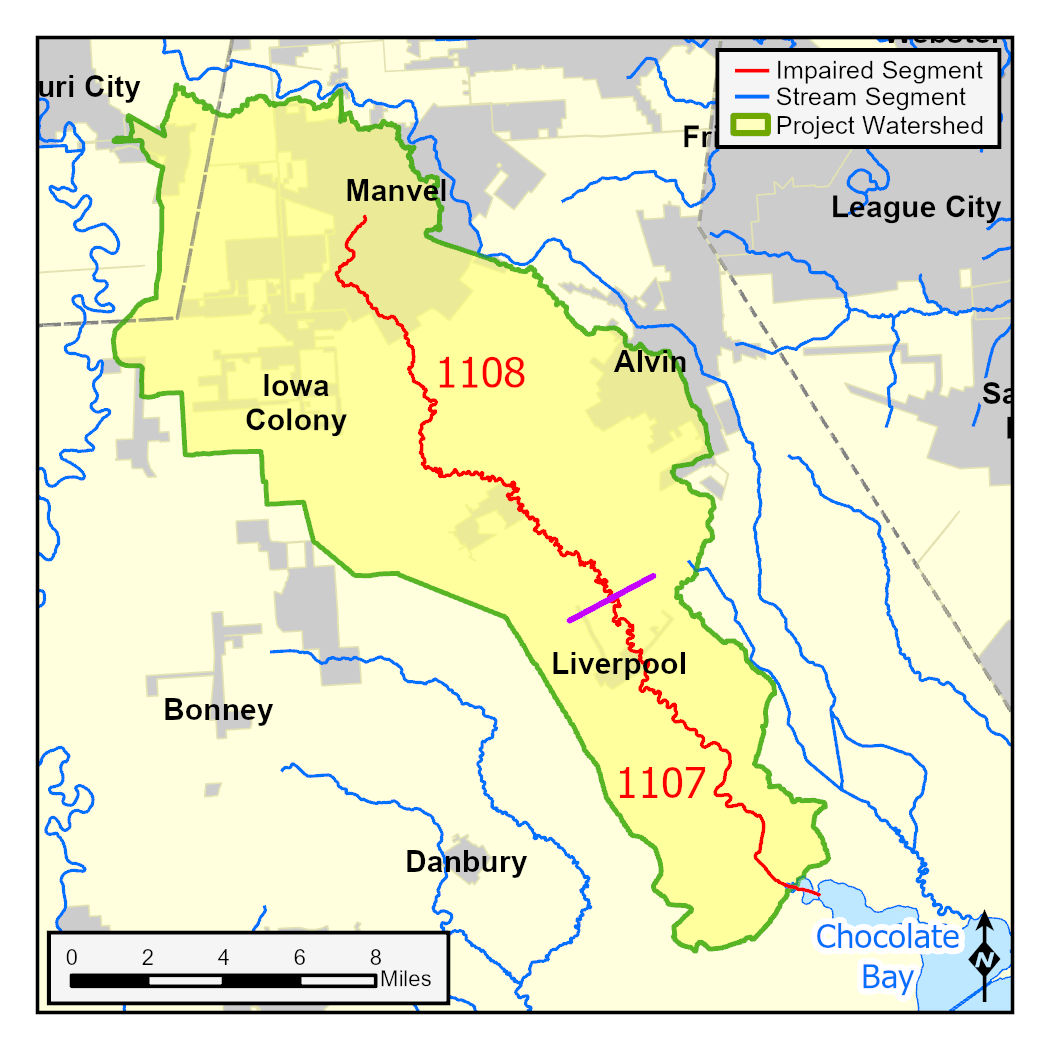
Chocolate Bayou lies in southeast Texas near the Houston-Galveston area. The bayou travels southeastward in eastern Brazoria County before emptying into Chocolate Bay, an embayment of West Galveston Bay. Its watershed includes the cities of Manvel, Liverpool, Alvin, Arcola, and Village of Iowa Colony. Most of the watershed is within Brazoria County, with a small area in Fort Bend County.
Chocolate Bayou Above Tidal (Segment 1108) has a watershed area of 110 square miles. The segment begins about 1.4 miles west of the city of Manvel in Brazoria County and flows for 22 miles to its boundary with the tidal segment. Chocolate Bayou Tidal (1107), with a watershed area of 37 square miles, begins northwest of the city of Liverpool in Brazoria County and travels 16 miles.
The bayou and its tributaries are generally sluggish due to the gentle sloping relief of the coastal plain. The bayou has been altered many times by instream channel modifications, the construction of supplemental drainage canals, and irrigation and supply canals.
The Above Tidal watershed had a population of 29,552 in 2015, more than 20 times the population of the tidal segment watershed in the same year. Land uses in the region range from urban developments to the north, northeast, and northwest, to more rural development in the south and west. Agricultural production remains a large economic base for the watershed, covering about 54% of the land area. There is heavy industrial development near Chocolate Bay.
Get Involved
In all its projects, TCEQ gathers opinions and information from people who represent government, permitted facilities, agriculture, business, environmental, and community and private interests in the watershed. Staff from the Houston-Galveston Area Council (H-GAC) have been working with stakeholders to distribute information about this project and involve them in developing the I-Plan for watershed improvement.
All public meetings about this project are open to anyone interested. See meeting records in the "Get Involved" section of the H-GAC's webpage San Jacinto-Brazos Coastal Basin Bacteria Reduction Project .
Adopted TMDLs
The Commission adopted these TMDLs on May 22, 2024. EPA approved them on July 26, 2024, at which time they became an update to the state's Water Quality Management Plan.
Reports
H-GAC staff completed a draft technical report in 2022 that compiled and analyzed all available bacteria data and considered sources of the bacteria and their relative contributions.
Contact the TMDL Program
Please email tmdl@tceq.texas.gov, and mention the Chocolate Bayou bacteria project in the subject line. Or call us at 512-239-6682.
 Back to top